
Octopus Workshop 2026
OCTOPUS Workshop 2026 Strengthens International Collaboration in Marine Robotics and AI
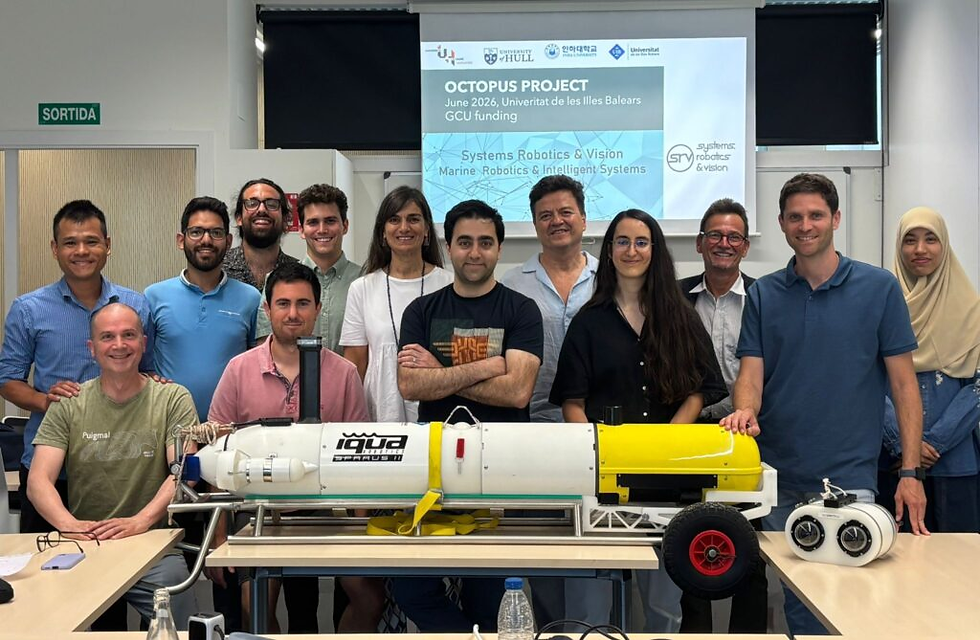
On 22–23 June 2026, the Marine Robotics and Intelligent Systems group at the Universitat de les Illes Balears hosted the OCTOPUS Workshop 2026 in Palma de Mallorca. The event brought together researchers from Université Le Havre Normandie, the University of Hull, and Inha University to discuss progress, exchange ideas, and shape the next phase of collaboration.
Across the two-day workshop, partners reviewed the current achievements of the OCTOPUS project and shared recent developments in autonomous marine robotics, artificial intelligence, and environmental monitoring. The meeting provided an important opportunity to align the consortium’s research priorities and define a shared plan for future work.
A key outcome of the workshop was the agreement to develop a joint publication plan and prepare future international funding proposals. The partners identified the MSCA Doctoral Networks 2026 scheme and Horizon Europe Mission Ocean 2027 calls as strong opportunities for continued collaboration. These future proposals are expected to focus on areas such as marine environmental monitoring, resilient ports, and ecosystem restoration.
The discussions also highlighted two major research directions for the consortium. The first focuses on AI-enabled and robotic technologies for pollution detection and prevention, including the integration of cybersecurity considerations. The second centres on the use of autonomous robotic platforms and artificial intelligence to monitor, understand, and protect marine ecosystems.
The OCTOPUS Workshop 2026 marked an important step in strengthening the international partnership between the participating institutions. By combining expertise in robotics, AI, marine systems, and environmental monitoring, the consortium aims to contribute to more sustainable and intelligent solutions for protecting marine and coastal environments.
This workshop also reinforced the shared ambition of the partners to move from project-level collaboration towards a longer-term international research roadmap. Through joint publications, doctoral training opportunities, and future European funding proposals, OCTOPUS is helping to build a strong foundation for the next generation of autonomous marine robotics and AI-driven ocean monitoring.


Comments